Prices Relatively Stable, Considering...

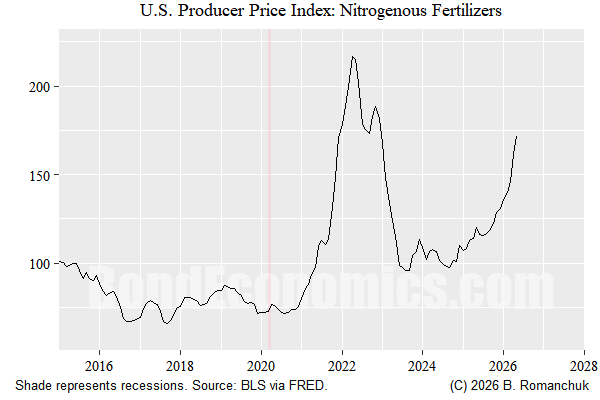
Despite the shrinkage of commodity flows out of the Persian Gulf, prices have been more stable than I certainly expected given how long supplies have been cut back. The chart above is one of the few scary charts I could find — a sub-category of the Producer Price Index (PPI): “synthetic ammonia, nitric acid, ammonium compounds, and urea.” (Phosphate fertilizers are less affected by the war, as the nitrogen compounds are synthesized with a lot of natural gas inputs.) Even so, the recent run-up is still less pronounced than the post-COVID spike.
Although rising fertilizer prices will squeeze farmers and/or raise unprocessed food prices, the multiplier through to the Consumer Price Index (CPI) is going to be muted. There is a lot of processing in the basket of foods consumed in the industrial democracies, as well as the costs of logistics and retailing that need to be reflected in the final price on grocery store shelves. Meanwhile, the weighting of food is small relative to services within the CPI.
In order to move the CPI in a very noticeable way, we would need to see crude oil/refined product prices to spike. The crude oil complex are the only commodity inputs that have the index weight and lack of retailer overhead costs over wholesale prices to pump up the CPI quickly. So far, releases of strategic reserves globally appear to have contained this.
Additionally, there was presumably some demand destruction by the price hikes we did have, making it easier for the energy markets to absorb the shock.
I am not attempting to be a forecaster, but on the condition that oil prices remain somewhat well-behaved, it seems reasonable to expect that the inflation bump we have had will in fact be transitory. The other “Trump shocks” for inflation have been milder than projected (mainly because he backed down on the insane tariff levels and the courts threw out most of the rest). Since the uncertainty has dropped some exuberance from the private sector, it seems unlikely that firms will bid up wages and thus create second round inflation effects.
Although crude oil inventories are dropping, the people who trade energy for a living do not seem to be alarmed, so I will not attempt to second-guess them.